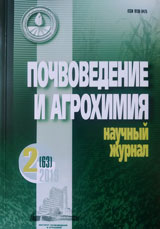
The journal "Soil Science and Agrochemistry" presents theoretical and practical results of research in the field of soil science, mineralogy, agrochemistry, plant nutrition, microbiology, ecology, including radioecology. The journal is indexed in the Russian Science Citation Index (RSCI). Full texts of articles are available on the website of the Scientific Electronic Library eLIBRARY.RU at: https://elibrary.ru/contents.asp?titleid=54408
Current issue
1. SOIL RESOURCES AND THEIR RATIONAL USE
The conducted research revealed relationships between soybean and millet grain yields and physical clay content and humus reserves in the studied soils of varying particle size distributions. The correlation coefficients (ŋ) for soybeans were 0,68 and 0,70, respectively, while those for millet were 0,63 and 0,57. Regression equations were derived for predicting changes in soybean and millet yields based on changes in the values of these parameters and for constructing soil fertility models.
Soybean and millet yield ranges were established for 11 soil varieties of sod-podzolic soils with different particle size distributions and underlying conditions. The highest average long-term soybean yield was observed on deep sod-podzolic medium- and light loamy soils – 28,4 c/ha, the lowest – on deep cohesive sandy soils and soils transitioning to loose – 9,5 c/ha. The highest average millet grain yield was obtained on deep sod-podzolic cohesive sandy loam soils underlain by light and medium loams – 38,6 c/ha, the lowest – on deep cohesive sandy soils transitioning to loose – 14,7 c/ha.
Based on the obtained yield data for soybeans and millet on sod-podzolic soils with light loam, cohesive, loose sandy loam, and cohesive sand textures and statistical processing, a qualitative assessment of these soils was conducted and their fertility scores were calculated. The highest soil quality score for soybeans was obtained for medium and light loamy deep soils – 63, while the lowest – 21 – was obtained for cohesive sandy deep soils and soils transitioning to loose soils. For millet, the highest score was assigned to cohesive sandy loam soils with a deep base of light and medium loams – 60, while the lowest score was assigned to cohesive sandy soils with a deep base of soils transitioning to loose soils – 23. The scores obtained are the initial ones, and to determine the actual score for a specific field or working area, if necessary, correction factors must be applied.
This study examines the need to consider in-field soil acidity distribution characteristics during liming, using two agricultural fields (18,6 and 30 hectares) with sod-podzolic light loamy soils as an example. A rationale is provided for transitioning to a more modern methodological and technological level of CaCO3 application, based on modern methods of processing and analyzing geodata and geostatistics. The features of grid point sampling and its advantages over the elementary plot method are described. Calculations show that the average profitability of liming in the studied fields is 55,0 and 40,4 %, with an income of $249,8 and $208,6 for the first and second plots, respectively ($13,7 and $6,75/ha). Based on the calculations, it is suggested that it is necessary to reduce the liming doses when taking into account the spatial distribution of soil acidity in the field for acidity group iii.
2. SOIL FERTILITY AND FERTILIZATION
The studies were conducted to investigate various fertilizer systems for cultivating winter wheat in a technological experiment on a highly cultivated sod-podzolic loamy soil. The most effective fertilizer systems for cultivating winter wheat in a crop rotation were the combined use of full mineral fertilizer N160P20/30K35/60 and mono-nitrogen (N160) in combination with micronutrient fertilizer MicroStim-Copper, Manganese, and plant growth stimulant in the background of the third year of straw manure and green manure. The use of such fertilizer systems ensures the production of up to 76 centners of grain of class 2 quality with a protein content of 13 %, a gluten content of 30 %, and high agro-economic efficiency of cultivation. The specific removal of the main nutrients by winter wheat at this level of yield is as follows make up: N – 21,9 kg/ha, P2O5 – 7,7 kg/ha, K2O – 9,3 kg/ha.
The results of the comparative effectiveness of lime ameliorants (raw ground dolomite, granulated and dusted dolomite flour) against NPK in the first year of application for spring wheat cultivation (2024) and in the first year of post-application for pea-oat mixture cultivation (2025) are presented. The impact of lime ameliorants on the yield of these crops, the quality of primary and secondary products, and the shift in soil acidity from 1 ton of lime ameliorants in the year of application and the first year of post-application is demonstrated.
This article presents the results of studies on the effectiveness of foliar zinc fertilization of agricultural crops at different levels of zinc availability in sandy loam soil. Foliar zinc fertilization is most effective in sandy loam soils with low and moderate levels of available zinc. Zinc uptake by plantsin creases linearly with increasing soil concentration and zinc fertilizer application rate
Liming of acidic soils was a priority protective measure, and large-scale application of dolomite flour in high doses made it possible to practically optimize the state of soil acidity of radionuclide-contaminated lands and minimize the transfer of radionuclides into crop production. The results of research on the effectiveness of optimizing soil acidity optimization to reduce the collective irradiation dose of strontium-90 to the population of the Republic of Belarus are presented. Based on the cost-benefit analysis, it is shown that the cost of preventing a collective dose as a result of liming of soils for grain feed crops is 200–1600 $ per 1 person.-Sv per hectare depending on the density of strontium-90 soil contamination and their acidity.
A high effect on preventing the collective dose of strontium-90 at the cultivation of grain feed crops can be expected when liming sod-podzolic soils with a strontium-90 contamination density of more than 0,30 Ki/km2 (11 kBq/m2). Currently, the share of arable lands with a strontium-90 contamination density of over 0,30 Ki/km is no more than 62 thousand hectares. The share of acidic soils (less than 5,5 pHKCl on which high efficiency can be achieved in preventing collective dose by optimization soil acidity is 26 % in the Gomel region and 29 % in the Mogilev region.
The recommendations provide agroeconomically justified doses, combinations and timing of application of nitrogen, copper, manganese and zinc fertilizers for the cultivation of winter barley on sod-podzolic sandy loam and light loamy soils, providing increased yield and product quality.
The developed recommendations for highly cultivated sod-podzolic loam soils consider new methodological and practical provisions for the effective use of fertilizer systems depending on the level of intensification of winter rapeseed and grain crops cultivation in the crop rotation link. A new regulatory framework is presented for the complex use of macro- and micro-fertilizers, plant growth stimulants against the background of the post-action of straw manure and siderate.
Requirements have been established for the implementation of technological operations for the effective use of fertilizers for winter and spring crops with a yield of up to 7,6 t/ha of grain and winter rape up to 3,9 t/ha of oilseeds in the link of fruitshifting crop rotation of various levels of inten-sification, preservation of the fertility of sod-podzolic loamy soils.
Agronomically justified doses and terms of application of fertilizers for forage beans have been developed, depending on the method of basic processing and the degree of cultivation of sod-podzolic soils, standards for the specific removal of nutrients by the crop of corn beans and standards for the accumulation of crop and root residues by forage beans are presented and the contents of the batteries in them.
This article provides a historical perspective on the development of herbicide product lines worldwide and in the Republic of Belarus over a period of more than 80 years, from the 1940s to the present. Currently, the range of herbicides for major agricultural crops in the Republic of Belarus is almost complete. Prospects in herbology include a transition from overall chemical spraying to localized application of products using unmanned aerial vehicles (agrodrones), new premixes, and bioherbicides, which reduces the pesticide load and increases the effectiveness of weed control; development and use of new forms of environmentally safe herbicides with high selectivity.